
Ports of Entry:
Tibet, Peru, Mexico, Journals 1999 – 2011
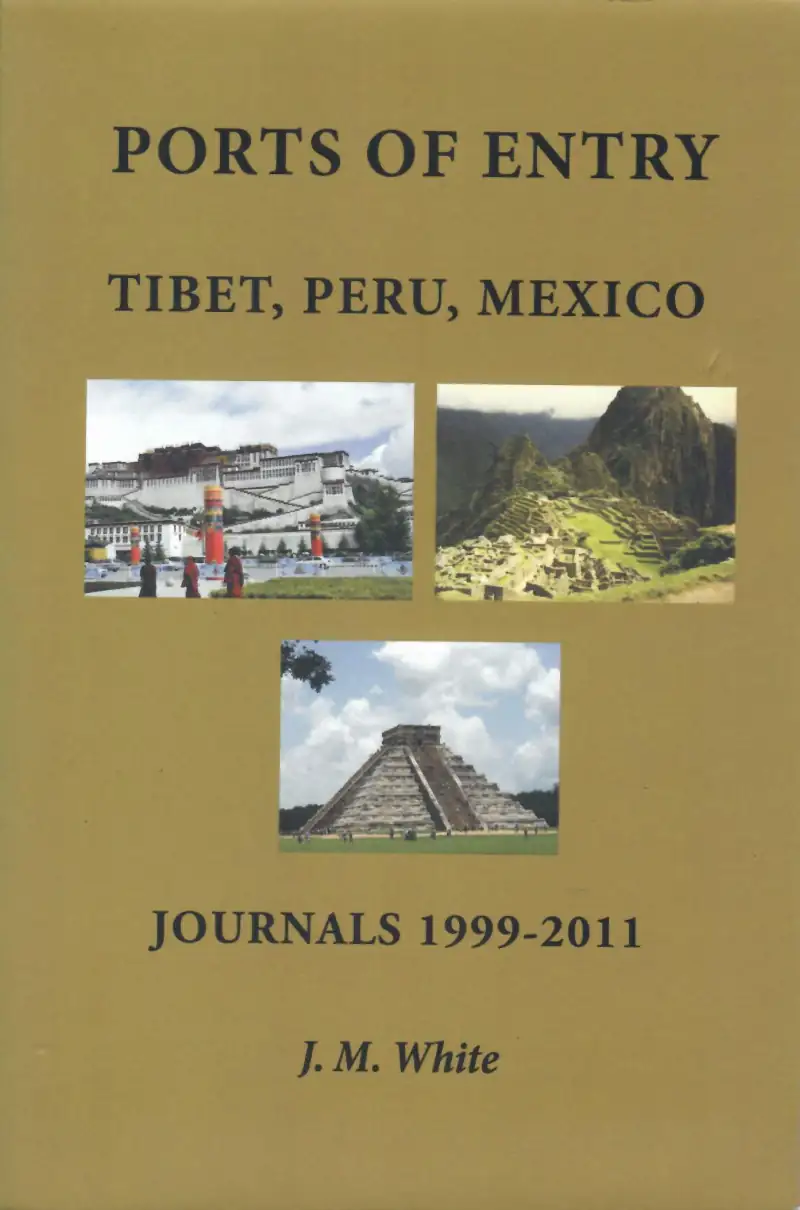
Ports of Entry:
Tibet, Peru, Mexico, Journals 1999 – 2011
J. M. White wrote and published Ports of Entry in 2016 and it was published by Anomolaic Press, Brush Creek, TN, 2015
This book is available for purchase at Amazon.com.
About Ports of Entry
Tibet, Peru, Mexico, Journals 1999 – 2011
About Ports of Entry
This book is a memoir and a travel adventure covering trips to Tibet, Peru and Mexico to explore the culture and history of these three remote areas of the world. In the Introduction to the book I write:
The moon journeys around the earth, the earth around the sun, the seasons wander on their rounds, so it has been for as long as humans can remember. And now this peripatetic traveler looks out upon the world where every day is a journey and sees that the journey itself is home. We prepare, such as we can, take what we think is needed, and set out. Some never return. Travel is filled with peril. We endeavor to reach far-flung places, walk on narrow rocky paths, peer into deep precipices, venture near the edge and at each moment the end is nearer than we dare to think. When I return from the latest adventure I throw open the windows, air out the house and settle at my desk. Yet, when I am sitting at home I watch the clouds windblown across the sky, hear the whistle of the train, lonesome in the distance, and it draws me to the dream of wandering. Before long I feel the tug of some invisible force and know it is time to pack my bags. I prepare my papers and find a blank journal. It’s time to go.
The Introduction to the first entry about travels in Tibet:
The Potala, the great palace of the Dalai Lama, one of the architectural wonders of the world, seems to grow out of the hill where it is built. Inside the Potala we are in a large ceremonial chapel filled with a long row of life sized statues when Jerry, our American guide, runs into a Tibetan he knows. The man is a very high lama dressed in robes. They are delighted to find each other and Jerry has gifts for him. They embrace and talk for a few minutes and then we continue on the tour route. We are moving down this long corridor with a stream of other tourists and pilgrims when all at once a door opens and the lama that Jerry knows steps out and beckons for us to come through the door. I couldn’t be more surprised. Suddenly we are off the tourist track and going into the back rooms of the Potala. He takes us through several rooms where there are no tourists, deep into the interior of the building, until we end up in a room with brightly colored murals and incredibly elaborate woodwork and long beautiful tasseled umbrellas that hang from the tall ceiling. This amazing room is where he works.
Tsewang, our Tibetan translator, tells us that the lama’s job is repainting some of the murals. He is currently working in a room that has thousands of pages of manuscripts that some lamas are trying to put back together like a giant literary jigsaw puzzle. On one side are tables filled with loose pages of Tibetan books. On the other side are piles of texts on the floor, all of them wrapped in fabric where they have managed to reassemble the pages. There were great libraries in the Potala and the Chinese had thrown down the books and scattered the pages, many of them were burned and many were left in huge piles. We get to stand with him in front of one of the murals for a few minutes and he lets us take pictures of the room, knowing full well no photographs are allowed inside the Potala and we take group pictures of all of us together with him. It is a very large room and the walls are covered with ornate elaborate woodwork around the top of the room and around the beautifully painted doors with traditional door handles. I get Jerry’s attention and tell him I have a question, he nods and Tsewang translates. I feel like this guy has done us a big favor so I have Tsewang ask,
“Is there anything we can get you from America?”
“Yes, I need heart medicine.”
I am surprised and assume that he has a heart condition of some sort and needs medicines that he can’t get here in Tibet. Then he looks at us and says,
“We need medicine for a broken heart, for all the young people.”
It is courageous of him to speak with us privately at all. Here in Lhasa if a Tibetan monk talks to Westerners he can end up being interrogated by the Chinese who want a full report on everything that was said and he can even end up in jail as a result. So I understand the pressure, the fire in the belly of being under constant oppression, of going to classes every month where they are forced to denounce the Dalai Lama and swear allegiance to China. It is truly heartbreaking and my sympathy goes out to him and the Tibetan people who are forced into this awful situation.
Introduction to the section on travels in Peru:
The plane trip is only six hours from Atlanta to Lima, due south. Lima is like any large city anywhere, but Cusco, only a few hours plane ride from Lima is another world. Landing in Cusco is a step into indigenous culture; it is a place where the ancient traditions of non-Western religion, medicine, poetry, culture and language have managed to survive and are now experiencing a rebirth. It is an exotic flower that had been trammeled underfoot by Western Christian European/American imperialism for hundreds of years but due in part to its remoteness and to the sheer persistence of cultural traditions it has survived and has now in the past twenty years been able to resurface to openly celebrate the ancient ceremonies, healing practices and other old ways. After nearly five hundred years of suppression the trend has finally begun to shift such that foreigners are no longer coming only to practice cultural genocide and economic exploitation but rather to gain access to the spiritual traditions and show respect to the old ways.
The Protestants and Catholics and even the Mormons, along with the forces of capitalism and modernity ,are clashing with traditional cultures in every remote corner of the world. The Protestant “great commission” would happily wipe out all vestiges of traditional tribal non-Christian religion and forces of democratic capitalism would market a money economy with satellite television to every village.
Yet in the face of five hundred years of brutal armed repression and hundreds of years of attempted acculturation there still remain a few places like Cusco and the highlands of Peru where traditional ways are still alive, where contact can be made. The values of Western democratic urban capitalist money economy and Christian spirituality is so remote from the indigenous agrarian tribal barter economy and pantheistic religious village traditions that only a traveler who can stand above his or her own prejudices and cultural values can move smoothly in this terrain. To go to these places is a challenging test of your ability to move into that space where we are all the same human being, to accept the diversity of human culture and find the space inside yourself where all cultures and traditions are ornaments of human awareness worn by different people in different historic and geographic locations. Travel in itself reveals human nature, reveals the plasticity of human nature as it manifests across time and space in the incredible variety of cultures, religions and languages.
From this chauvinistic point of view only those people who adopt “my” values are really human beings. Once this attitude is endemic then there are just two basic strategies in regards to indigenous cultures: either kill them off or assimilate them. So it is only in the most remote areas of the world that traditional non-Western values have managed to survive and this is one of them. There are over a hundred communities in Peru that are above 14,000 feet. This has provided a place where non-Western indigenous traditions survive. So there are, around the globe, small pockets where indigenous culture is still alive and flourishing. And now, as there always have been, there are travelers who seek out these places and find a sort of “homecoming” in being able to contact and communicate with these cultures. It is not only a lesson in the diversity and plasticity of human nature but also a return to a type of cultural experience that was once at the root of the historical lineage of each of us. A remembrance that it was only a matter of some generations ago that our own ancestors lived in a tribal cultural with a non-Christian, non-Western, non- capitalistic way of life.
Introduction to the section on Mexico:
In ancient times humans had immediate experience of the gods, they had direct contact with the divine, could feel the rushing energy of the numinous presence of the supernatural in the psychedelic experience of peyote, yage, San Pedro, and the psilocybin mushroom. All these were taken in ritual context with a priest or priestess administering the sacraments in a temple or a cave. The experience of heightened awareness and speeding intensity of the drug was, in their religion, a divine communion with the higher spirits of the earth.
They created temples of such architectural splendor and astronomical precision that we are still deciphering the information encoded in these monuments. These places are haunted by the cult of sacrifice, where they practiced a religion that demanded sacrifice by everyone including the Kings who gave blood from their ears or penis. These were sacrifices to propitiate the supernatural, to keep the gods happy so that all the forces of nature will work in harmony and the cycles of nature will function to benefit all, but the price was high, with human sacrifice in these same temples, temples of majestic beauty ornamented with works of art with abstract designs, hieroglyphs and sculptures of humans, animals and skulls covering the palaces and pyramids.
Six A.M. and the alarm sounds. Susan springs to life to shower and we head to the airport and catch a plan for Miami. I read Arthur Demerst’s paper on Mayan ideology during the flight. We land in Miami and quickly board the plane for Cancun. I watch Miami disappear behind us and am surprised how fast we cross the bottom of the Florida peninsula and are out over the Gulf of Mexico. I finish the Demerst article and drink a glass of wine and, to my surprise, see land across the horizon. As we approach the shoreline the water is the most beautiful blue I have ever seen. The water appears to be a crystal clear blue translucence contrasted to the gleaming white sand on the beaches and the deep green of the palm trees and jungle behind the beaches. Then, before I know it, we are landing in Mexico. We clear customs and pick up a car and are driving across the Yucatan to Chichen Itza.