
Italian Journals By Gregory Corso
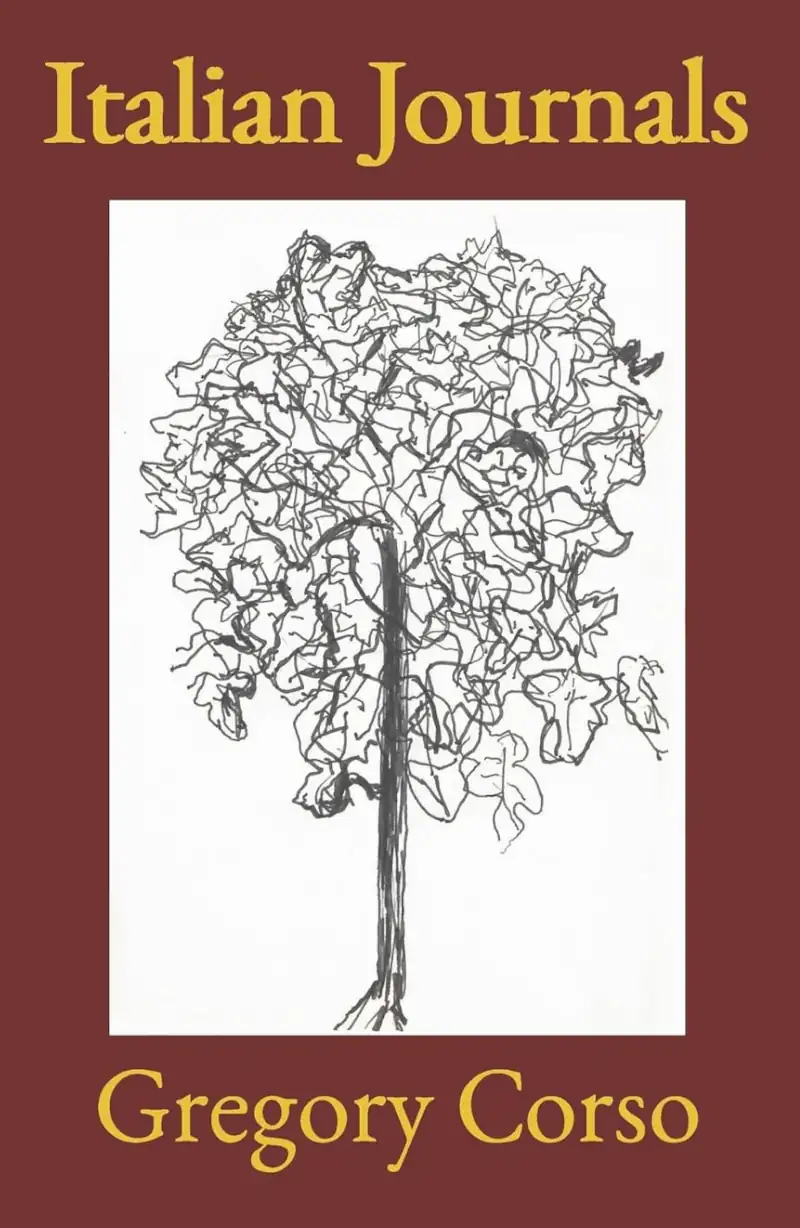
Italian Journals By Gregory Corso
J. M. White wrote and published Italian Journals in 2025. It was published by Anomolaic Press, Brush Creek, TN, 2015
Read about the book and a review by Gregory Stephenson below.
This book is available for purchase at Amazon.com.
About Italian Journals By Gregory Corso
Gregory Corso’s Italian Journals are a poetic snapshot of his time in Rome in 1988. It is not a journal of his day-to-day activities but rather of his thoughts and reactions in the form of over forty poems. He also used it as a sketchbook to record sketches of some of the places around Rome he was visiting. The Italian Journals include both the poems and the sketches to provide an intimate account of his life during his stay in Rome. These poetic journal entries describe hanging out in the bars and visiting the graves of the poets he admired as well as his feelings of angst over his life as a poet and his relationship to God. The second part of the book is a brief memoir recounting what it was like to be around Gregory Corso during the 1980s when he was teaching at the Jack Kerouac School of Disembodied Poetics at Naropa College in Boulder, Colorado until his death in 2001.
Gregory Corso was born in 1930 and grew up at the corner of Bleeker Street and MacDougal in the heart of Greenwich Village in Manhattan. His mother immigrated from Italy when she was nine and married at sixteen to a local teenage Italian American. Gregory was born Nunzio and chose the name Gregory himself. He was abandoned by his mother before he was one year old and his father placed him in a series of foster homes. He was homeless for much of his youth, sleeping in the subways in the winter and on rooftops in the summer. He was an outstanding student and attended parochial school. He was arrested at age thirteen and went to the Tombs, the most infamous prison in New York City. The cell next to his housed a serial murderer. He got out and was quickly arrested again and sent right back to the Tombs. On turning eighteen he was arrested as an adult and sentenced to three years at Clinton State Prison where “Lucky” Luciano and other mobsters were incarcerated. He met Allen Ginsberg when he was twenty-one hanging out at a lesbian bar in Manhattan. Allen immediately recognized Gregory as a kindred spirit and they became lifelong friends. He subsequently met Kerouac and was integrated into the heart of the Beat literary circle. He is the main character in Kerouac’s book The Subterraneans. He published widely in literary magazines and New Directions Press brought out a series of his slender volumes of poetry. In 1989 Thunder Mouth Press came out with an anthology of his poetry called Mindfield: New and Selected Poems. Both Burroughs and Ginsberg wrote Introductions for him. He died of cancer in 2001 and is buried in Rome.
Following is a review by Gregory Stephenson that initially appeared in Eclectica Magazine and can be found here: https://www.eclectica.org/v30n2/stephenson_corso.html
Restless, wayward, drink-and-drug-driven, Gregory Corso (1930—2000) left scattered in his turbulent wake numerous unpublished manuscripts, including poems, plays, half-finished essays, notebooks and journals. These literary remains, abandoned, bestowed as gifts or sold by Corso, are currently housed in a score or more of university libraries (access by appointment only) and dispersed into various private collections. This being the case, the unexpected appearance of these Italian Journals in book form will—by admirers of the writings of Gregory Corso, or of the literature of the Beat Generation—be received with elation.
The book consists of two sections, the first comprising 33 pages of untitled poems and aphoristic jottings set down in a journal kept by Corso (then aged 58) during a sojourn in Rome in 1988; with the second portion of the volume, 48 pages in length, being composed of a Postscript written by the editor, J.M. White, in the form of a memoir of his acquaintance with the poet. There are, in addition, three pen-and-ink illustrations by Corso (four counting the drawing appearing on the dust jacket.) Readers recalling the verve and verbal flights of Corso’s early poetry will be surprised to encounter in these pages sparse, stark, short poems. The terse, concise style deployed by Corso here reflects the dominant mood and recurrent theme of the poems, which is that of regret and relentless self-accusation.
It is unclear whether Corso intended any of the poems in this journal for publication. They seem in many instances to be drafts or fragments of poems, largely unadorned by figurative language, minimally punctuated, intermittently end-rhymed, rough-edged, blunt, abrupt, unresolved. Yet it is this very attribute—their nakedness, their raw candor—that lends them potency and pathos. In one poem, Corso sets forth his new aesthetic: “I would bare my heart and soul / of poetry / without intentional embellishment / the bare bone of a poem.” Written in this spirit, these poems may be said to be deliberately anti-lyrical, marked by a refusal to assume any longer what Corso refers to as “the baubles… of watered down truth,” eschewing, that is, conventional poetic devices that might soften or distract from the painful clarity he strives to render into words.
In contrast to the wide imaginative scope of Corso’s earlier poetry, the poems in the journal are, for the most part, more narrowly focused, consisting of immediate impressions and intimate reflections. Corso relishes the beauty and temporal depth of Rome, but he is also troubled by the city’s dark undercurrents, its “blank-faced” underclass inhabitants, its ubiquitous thieves, “the strutting loud mouth,” the ignorant pregnant young girl, the belligerent “hyena-like” youths who hold sway over its side streets and squares, the dead body of a young man sprawled on a cobblestone street.
More oppressive to Corso, though, are the dark undercurrents within his mind, arising from a deep interior abyss. Already aged several years past the Dantean milestone of having travelled midway on life’s journey, Corso writes: “I saw myself / As I never looked before—/ A man who finally had enough of himself.” He is, he finds, “weighted with uncertainty / With insufferable memory… a toothless sad / Small thing of a man.” Ruefully, he acknowledges: “I am destroying whatever good I’ve done in life / And not out of bitterness / Worse / Out of stupidity.” His brightest energies dissipated, his rambustious vitality depleted, the world around him no longer familiar or comprehensible, Corso deems himself to be “like a guest who overstayed his welcome / who feels life doesn’t want him anymore—.”
In other poems here, Corso gropes toward some form of metaphysical orientation. Out of “hubrisian ignorance,” he laments, he denied God. Now he fears to admit God’s existence, since to do so would be to acknowledge being known by God, known in all ones squalid spiritual state. Corso even dreads, he tells us, to encounter priests in the streets of the city, nervously avoiding their gaze because he trembles to think that they might somehow detect his tainted nature. And yet, from the inward abyss into which he has fallen, Corso retrieves these brave, “bare bone” poems, a series of damage reports as performed by “an agony of trombones.”
As noted above, the second section of the book takes the form of a memoir written by the editor of Italian Journals, J. M. White. White recounts incidents and conversations from a friendship with Corso spanning several years. Corso, constantly in need of money to buy heroin, could be inconsiderate and unreliable, but he could also be kind and generous. White is patient and tolerant with his friend, recognizing that Corso inhabits, as the poet himself expresses it, “a hell realm” of drugs. At one point in their acquaintance, Corso rummages in his duffle bag and produces a small, black notebook, the journal of his sojourn in Rome, offering to sell it to White for three hundred dollars. White accepts, takes possession, and has guarded the journal these many years, keeping it in a safety deposit box. Only recently did White decide to re-read Corso’s journal, quickly realizing its vital place in the poet’s body of work. White’s wife, Susan, deciphering Corso’s cursive handwriting, typed the poems, and now we have this handsome hardbound book from the Anomolaic Press.
For readers unacquainted with Gregory Corso’s work, Italian Journals would not, I think, make for an appealing introduction. The poems printed here are far from being among his finest achievements. That said, for Corso devotees, the book will be a windfall feast.